
Years ago I used to subscribe to Family Fun magazine, and this recipe was included in the October 1999 issue. It’s simple enough for even the most casual cook to make, and it’s really delicious.
THE CRUST:
2 1/2 cups all-purpose flour
2 tablespoons sugar
1/4 teaspoon salt
8 tablespoons ice water
The original recipe calls for 1/2 cup cold butter, cut into 1/2-inch pieces, and 5 tablespoons cold vegetable shortening. Possibly this makes a flakier crust than using all butter, but considering how spectacularly unhealthy partially-hydrogenated oils are, I’m willing to sacrifice whatever textural benefits Crisco offers. I substitute an equal amount of butter. Your mileage may vary.
The secret to a perfect piecrust is to keep all the ingredients COLD, and to not overmix the butter. The method Family Fun recommended is to measure the dry ingredients into a gallon-size Ziplock bag, seal and shake it to mix them, then add the chilled butter pieces (and shortening if you opt to go that route) and just sort of press them in. The idea is to flatten the butter and coat it with flour to produce a flaky, layered crust.
I use a regular mixing bowl and just flatten the butter pieces with my fingers before tossing them in with the flour mixture.
If you’re already an old hand at making pastry crusts, just do whatever you usually do. :^)
Once your chilled butter is LIGHTLY mixed in with the dry ingredients, add the ice water. If you’re using the Ziplock method, open the bag, add ice water, reseal, the press and shake until the dough holds together (add more water if necessary, but not too much!).
Turn the dough onto a lightly floured surface, knead it together, then divide in half. Work quickly, because you don’t want your butter to get warm and melt.
Flatten each half into a disk, wrap in plastic, and chill for at least 30 minutes.
Then roll out one of the disks on a lightly floured surface until you have a circle that’s about 12 inches in diameter. Line a 9-inch pie plate with the dough, trimming any extra dough from the edges with a sharp knife. Return it to the refrigerator until you’re ready to make the pie.
THE FILLING:
6 to 8 pie apples such as Granny Smith, Cortland, Rome, or a local variety of tart apples. I highly recommend using local apples whenever possible, ideally from a “U-Pick” orchard. A freshly-picked, locally-grown apple is always going to taste better than one that’s been trucked across the country, chemically ripened in a warehouse and then stacked under bright lights in a supermarket. Also, I think the small local growers tend to go a little easier on the chemical pesticides and whatnot than the big commercial growers. And if you can find a local organic orchard, score!
Okay, where was I? On my soapbox, apparently.
Juice of half a lemon
3/4 cup sugar
1 teaspoon cinnamon
1/4 teaspoon nutmeg.
2 tablespoons all-purpose flour
2 tablespoons butter, cut into chunks
milk (for glaze)
Heat oven to 425º.
Meanwhile, peel, core, and slice your apples into 1/4 inch slices. You should have about 6 cups worth of sliced apples; place them in a large mixing bowl.
Pour the lemon juice over the apples and add the sugar, cinnamon, nutmeg and flour. Toss well. Spoon the spiced apples into the lined piecrust and dot with the butter pieces.
The top crust can look like whatever you prefer. You can roll it out, cut it into strips, and make a latticework crust if you’re really ambitious. Or just roll it into a circle, set it atop the apple mixture, and crimp the edges together with the tines of a fork. Remember to cut slits in the dough to let the steam escape. Brush the top with milk for a glaze.
Place the pie in the preheated oven and bake for 45 minutes, or until the crust is golden brown and you can see the juices bubbling. If the crust begins to brown before the pie is fully baked, cover it with foil.
Let the pie cool before slicing it into wedges. Serves 8.
Sorry I don’t have a picture.
Hey wait — this is the Internet! Here ya go:
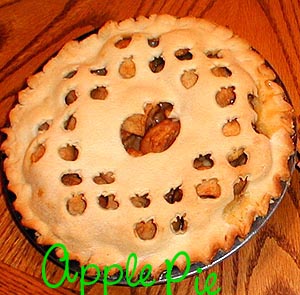
PS. If you actually succeed in making a pie that looks like the one in the picture, do let me know your secret. Mine come out very tasty but not nearly that pretty, and I’ve never gotten the hang of getting decorative cutouts to hold their shape during the transfer from countertop to pie.
 An Invincible Summer