kids

Everything But Money Part III: On Social Development

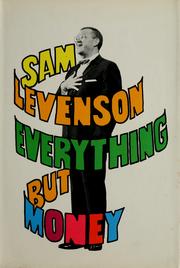
This is an excerpt from “Everything But Money” by Sam Levenson.

Part I

Part II

** ** **

Once we have done everything to insure the child’s recognition of himself, we have to make clear to him the relationship between his self and the selves of others. The nature of the individual’s involvement with other individuals cannot be taught too early, since this involvement starts with the child’s first breath and does not end until his last.

In a society which believes in education for all, the ultimate objective becomes living with all, even with those you don’t like. Social justice should have nothing to do with personal likes and dislikes. The Scripture says “Thou shalt love thy neighbor as thyself.” It does not say you have to like him, nor does it say “See footnote A regarding color, shape of nose, texture of hair, ethnic classification.”

…We make much of “toughening our youth.” They are tough enough. What they need is softening. Our education is heart-less. It is more important for the child’s first reader to say “Love, Dick, love” than “Jump, Dick, jump.”

…We underestimate the ability of our children to understand mercy, sympathy, and generosity. Just as they can be taught that flowers are pretty and dresses are pretty, they can also be taught that behavior can be beautiful or ugly, sweet or sour, kind or unkind, just or unjust, tender or cruel. Self-expression includes what not to say as well as what to say, and what you say is more important than how well you say it. It is just as vital to approach the world with an open heart as with an open mind. Boys should not be taught that it is unmanly to cry. Men should not be ashamed to weep at injustice. When men will weep at the horrors of current history the world may become better. The world needs a good cry.

…Every lesson should end in a moral and should answer the question, “In what way, directly or indirectly, does this lesson make for better human beings, a better country, a better world?” The acquisition of facts and skills for their own sake is generally accepted as education. Knowledge can be destructive of all that the human race considers sacred. The soul needs education as much as the mind.

…What good does it do a young American to know the subjunctive if he feels no sympathetic pain for a foreign child of his own age who goes to bed hungry every night of his life? The travel posters on the classroom walls never showed such scenes. Who would travel three thousand miles to see a little girl with a twisted spine carrying her sickly little sister on her back? Let no child be called “educated” until he has seen and discussed the ugly pictures and made some moral commitment to the advancement of other human beings beside himself, a commitment not to be his brother’s keeper, but his brother’s brother.

The world has had its fill of educated brutes, “brilliant” men who have led great masses of people back to barbarism. I have seen as much personal cruelty among college professors as amongst illiterates. Personal inhumanity is not unusual in college departments which teach the “Humanities.” I learned this at the tender age of twenty-one when my own college elected me to the Spanish Honor Society, but dissuaded me from applying for a full-time teaching position because the department “policy” at that time was opposed to “inbreeding,” a policy which at that same time did not apply to qualified students of other faiths.

Categories: books, kids, Life, Love, School | Leave a comment

Everything But Money Part II: On Finding One’s Voice

This is an excerpt from “Everything But Money” by Sam Levenson. Read Part I here.

** ** **

I regard overcrowded classrooms as a major menace to individuality. It is possible to educate masses but quite impossible to teach children in masses — especially little ones. I was involved in this futile procedure as a public-school teacher…I have seen the lifeless faces of children whose selves had never been revealed even to themselves, whose unique message will never be delivered. We should hold annual services at the grave of the Unknown Child to remind us of the millions of living children who never really come alive, whose souls remain in limbo in spite of our humanitarian declarations about the sanctity of the individual. Never to discover one’s self is never to be free. The road to personal freedom goes from cognition to self-cognition, to self-recognition, to the supreme joy of recognition by others.

A “class” is an arbitrary grouping of seemingly homogenous beings, no two of which are any more alike than two snowflakes. If it were possible to place children under a microscope, one would find the least of them inspiringly beautiful, distinctively designed. When we gather too many, flakes or children, the loveliness of individuality is lost and what we get is all white, the ultimate in neutrality.

There should be no more than fifteen children in any class. This is now being done for the “special” child. All children are special. They are not created equal. They are created different. There is hardly a child without some gift worth developing, some manifestation of his special being. All gifts are equally important. Each child’s contribution to the human race is to be celebrated with much rejoicing. It is the teacher’s duty to discover the seed of possibility in each child, to talent-scout the souls of little children, to insure to growth and fruition of what is best in this child, whether it is a talent for science, music, art, plumbing or gardening — to nurture his innate ability, to help him toward self-determination through a heightened awareness of his abilities by supplying educational hearing aids to amplify the inner voice for those who cannot hear it by themselves. His voice, once identified, becomes his purpose in life; this will be the voice that will speak his message. In an overcrowded class, as in any class, there is a good chance that only the loud voices will be heard.

In a society which claims to value individuality we have come to place so high a premium upon conformity in children that any deviant from the “norm” is promptly pounced upon as maladjusted. This, too, is a penalty imposed upon the exceptional child because of the large class. The child who feels, talks, thinks and behaves like all the rest is “doing fine.” Like the chameleon, he has learned to camouflage his identity to keep out of trouble. He presents no problem to the teacher. A good teacher should be disturbed when a child accepts everything in his environment, or even worse, becomes a hypocrite, junior grade, and feigns acceptance for fear of being declared an eccentric. The maladjusted child may be the true leader of his group. The fact that nobody follows him does not prove that he is wrong. No child should be declared maladjusted until we have given serious consideration to the possibility that we may be maladjusted, not he. He may be the one who is right, honest, sensitive, profound, and motivated by higher standards than the rest of us. Is it morally right to require adjustment to a society which is maladjusted? It is possible, even in a democracy, that the majority may be wrong. Inability to accept the status quo is not necessarily a sign of weakness. If the founding fathers of this country had all been well-adjusted we would still be a British colony.

…This country abounds in college graduates who have not yet found themselves, bewildered young men and women who wander from campus to campus in search of a “major,” not yet aware of the fact that the real major is one’s self.

Too many people end up earning a living, very often an excellent one, at work they do not love, work that bears little relation to their talents, or at best, does not “interfere” too much with their private lives. The world is full of these unhappy successfuls: doctors who should have been artists, and vice versa; dentists who should have been shoemakers, and vice versa; lawyers who should have been drummers, and vice versa. All are vocational misfits and malcontents who during their schooling were either separated from their talents or never were introduced to them. Ideally, a man should have only one regret about his work — that it ends. He should hate death primarily because it leaves his work unfinished. We are a hobby-happy country because so many men do not find joy in their work. They are split personalities living out lives not truly their own. They will never be at peace with themselves.

Categories: books, kids, Life, School | Leave a comment

Everything But Money, Part I

I’m reading an amazing non-fiction book right now. It’s called “Everything But Money,” by Sam Levenson, and it was first published in 1949. The edition I’m holding is the fourteenth printing, published in 1966, and it contains mentions of events as recent as 1965, so it must have been updated as it was reprinted.

The book is in four parts. In Part 1 the author (who was born in 1911) describes his childhood in the poorest slums of Brooklyn, NY. His parents were Jewish immigrants, I think from Russia or thereabouts, and they had eight kids altogether while barely managing to stave off starvation under conditions of the most abject poverty. Although “abject” might not be the right word: his parents never saw a lack of money as any kind of excuse to fail in life, and they put a great deal of effort into their children’s education and moral guidance. The author grew up in a family that was financially destitute but very rich in love and support. Because of this, he and his seven siblings all overcame the poverty of their childhood and became successful in their adult lives.

In Part 2 the author talks about how different the experience of family life and parenting his own children is in the environment of middle class affluence and national prosperity of the 1950’s and ’60’s. He wonders if in some ways the benefits of “the good life” are actually detrimental to the healthy development of the younger generations. He talks about the ways in which society is failing those generations. By modern (2012) standards, the America he lives in sounds impossibly sane and prosperous, a sad reminder of how far we’ve fallen since those post-WWII glory days. It leaves the reader with the wistful sense that if more people had thought the way he did things might have gotten better instead of worse.

Part 3 is basically a personal monologue describing the author’s own outlook on society in general and parenting in particular. I don’t know what Part 4 is about, because I haven’t gotten there yet. But Part 3 keeps blowing my mind in the best possible way. I’d like to share some excerpts from it here, over the next few days, because I think in these modern times those philosophies and values are more relevant than ever.

So here’s my first offering:

I believe that each newborn child arrives on earth with a message to deliver to mankind. Clenched in his little fist is some particle of yet unrevealed truth, some missing clue, which may solve the enigma of man’s destiny. He has a limited amount of time to fulfill his mission and he will never get a second chance — nor will we. He may be our last hope. He must be treated as top sacred.

In a cosmos in which all things appear to have a meaning, what is his meaning? We who are older and presumably wiser must find the key to unlock the secret he carries within himself. The lock cannot be forced. Our mission is to exercise the kind of loving care which will prompt the child to open his fist and offer up his truth, his individuality, the irreducible atom of his self. We must provide the kind of environment in which the child will joyfully deliver his message through complete self-fulfillment.

When he is born we give him a public name. This provides only tentative identification until he finds his own true name, his potential at birth so completely realized that he and his work and his name become one. To have lived without having “made a name for himself” is virtually to have died at birth. We cannot allow him to be born a VIP and to die anonymously, often ignominiously. We cannot afford the loss of a single soul. We have already lost too many.

** ** **

I’ll post more as I get the chance. Meanwhile, the book is currently out of print but you can read it online here for free.

Categories: books, Family, kids, Life | Leave a comment

Our Grand Adventure, Part III

Part I

Part II

**************************

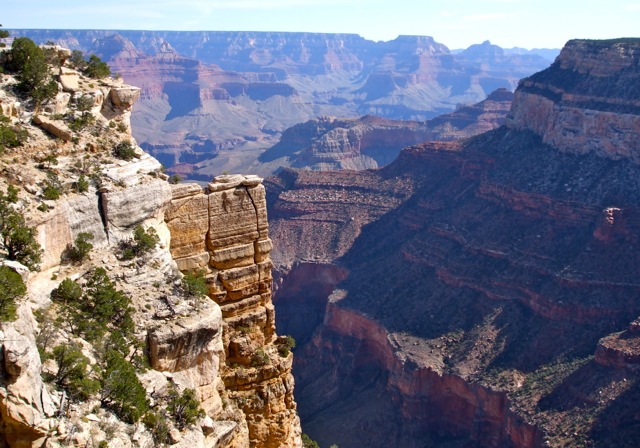
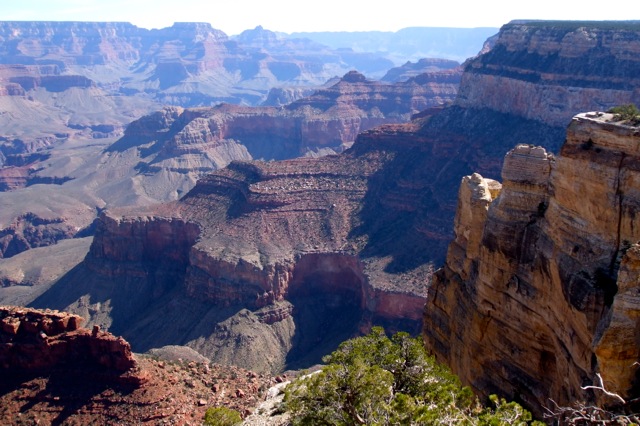
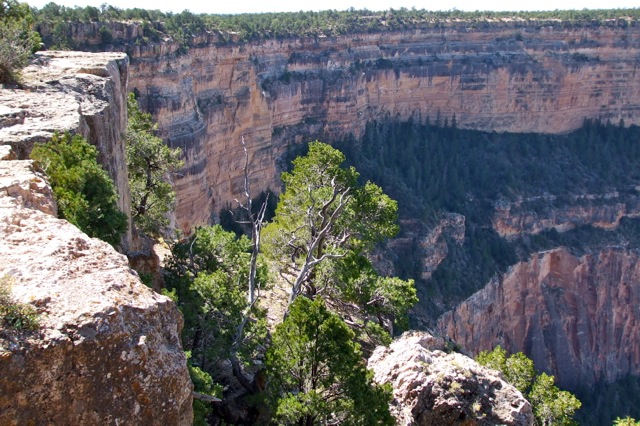
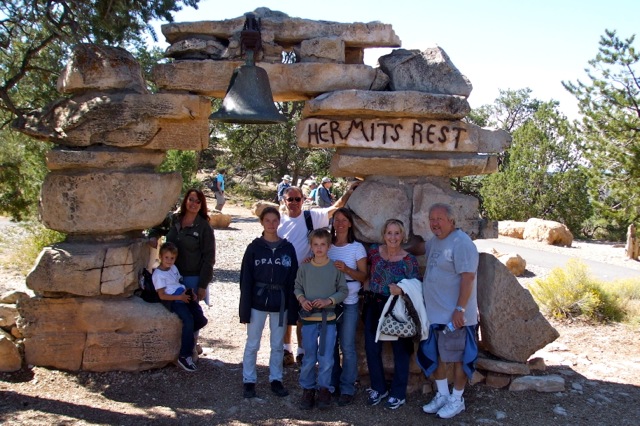
Monday’s hike was my favorite part of the whole trip: we travelled west from the Village along the Rim Trail to a spot called Hermit’s Rest about 7 miles away. Some of the group opted to take the shuttle, which ran on a separate road not far from the trail and stopped at eight big overlook points along the rim before stopping at Hermit’s Rest and looping back to the Village. There were ten of us that chose to walk, and it was a fun group. The trail was pretty and the views were amazing; it was just a great hike.

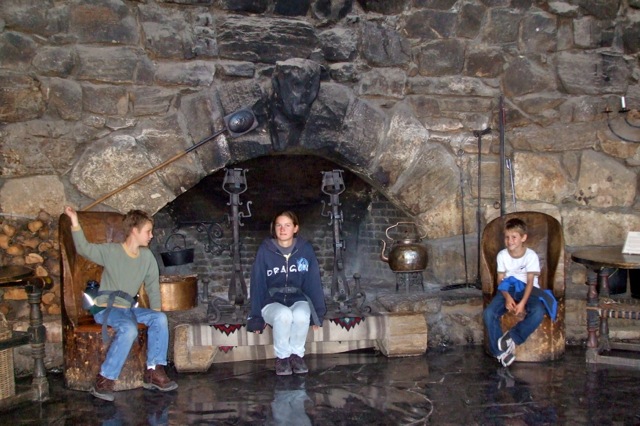
We ended up taking a shuttle the last three miles or so to Hermit’s rest, where we found an old (built in 1904) structure that had been converted into a gift shop and snack bar. Underneath all the modern clutter the primitive design was wonderful.

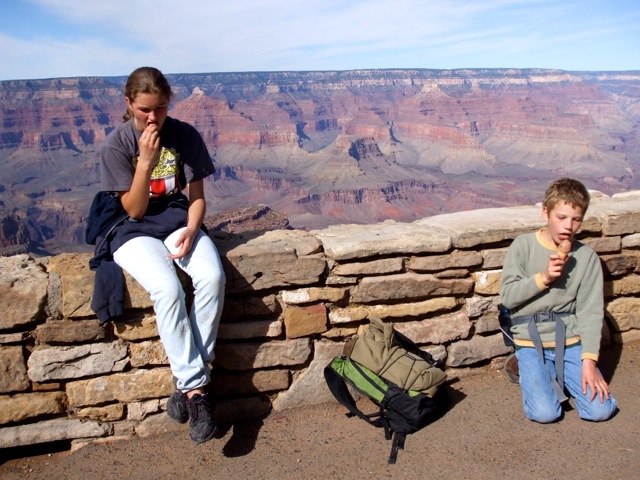
And now it was afternoon, and the one thing no one wanted to do was risk missing the train back to Williams, so we caught a shuttle back to the Village. The kids and I collected our carry-on stuff from the Lodge and then walked along the Rim Trail back toward the depot. We’d given ourselves plenty of time, so we stopped for ice cream along the way.

Luke had been wanting to look inside the Hopi House (like Hermit’s Rest it was built in 1904, designed by Mary Colter and eventually converted into a gift shop) ever since we’d arrived in the Village, so we stopped there next and had a look around. It was two stories high and crammed full of shiny merchandise, but the structure itself looked like a house I could see myself living in. It reminded me of my grandfather’s simple and beautiful hand-built shack, but with more fireplaces.

And then it was time to head down to the train depot…

…and settle in for the ride back to Williams.

We saw deer and elk from the train, but I wasn’t quick enough with my camera to catch them.

At one point we were overtaken and boarded by armed bandits.

They did a bit of comedy schtick that was pretty funny even to a cantankerous old fart like myself. The three of them came down the aisle demanding “money, jewels and prized possessions” from random passengers, mostly focusing on kids. When the first guy got to me and Luke, my boy dramatically turned his pockets inside-out to demonstrate his possessionless condition. While I was still laughing at that, the big gunman moved to the seats behind us, and I heard him suddenly exclaim in genuine surprise and bafflement, “She hissed at me!” I looked back and saw Elizabeth clutching her beloved picture of Espio to her chest and looking like the first robber that tried to lay a hand on her “prized possession” might lose it at the wrist. The bandit moved on without another word, and I didn’t blame him.

Sometime after the train robbers had left the car, Fiddle Guy returned. He told all the same jokes and played all the same bits of music as he had on Sunday, and they were still lame.

We rolled into the Williams Depot around 5:45pm, bought an obligatory Grand Canyon Railway Christmas ornament and a tee-shirt, and loaded up the Saturn for the long drive home.

I made one big mistake on this outing, and that was not printing out the driving instructions in BOTH directions. I didn’t think about it until we were already in Arizona, and then I figured it wouldn’t really matter because I could just follow my printed instructions except in reverse. The trouble was that without actual exit names and numbers, it wasn’t as simple as it seemed. Specifically, it turns out that there is more than one way to get from I-40W to US-95S, and I managed to take the wrong one. By the time I’d realized my mistake I figured I might as well just keep going, since I knew I had to be on the 95 eventually anyway. The worrisome thing was, there was no sign of civilization for miles and miles and the AZ/CA border did not appear to be anywhere near where we’d left it on our way to Williams. I confess, I was beginning to quietly freak out a little. But Luke and Elizabeth responded to the situation with a combination of stoic acceptance and cheerful sense of adventure, and pretty soon we were making jokes about finally making it across the Arizona border only to find ourselves in New Mexico. If I have to be lost in the middle of nowhere, my kids are the people I want to be lost with.

Eventually we reached a town, and I stopped at a gas station to fill up and find out where the hell we were in relation to the border. So that’s when I found out that my poor choice of exits had brought us to Lake Havasu, well north of where we should have been, but that staying on the 95 was still our best bet. We eventually crossed the border in Parker and got back to Anza without any further incidents. The next day I google-mapped our detour and learned that I’d inadvertently added about 150 miles to our journey home. The baffling part was that it didn’t really take us that much longer at all. We left Williams at about 6:30 Monday afternoon and were home by 1am Tuesday morning, so about 6.5 hours. According to Google it should have taken over nine hours to travel home the way we did. Not that I’m complaining, mind you.

[EDIT: And now that I’ve had more sleep and checked the route again, ACCURATELY this time, I see that my improvised route only added about 15 miles to the trip. That would explain why it didn’t take us much longer. Whew.]

We slept like dead people, but surprisingly had no trouble getting up the next morning and getting the kids off to school. As eventful and sleepless as our outing had been, it left us more energized than exhausted.

I’ll say it again: the Grand Canyon is amazing. It really is one of the great wonders of the natural world, something everyone should see at least once. The kids haven’t stopped talking about it since we got back.

Still…it’s good to be home.

Categories: Family, Friends, Humor, kids, Life, Love, Road trip, Travel | Tags: , | 4 Comments

Our Grand Adventure, Part II

Read Part I Here

The South Rim of the Grand Canyon is at 7000ft elevation. The weather was as perfect as it possibly could have been for hiking, but the thinner atmosphere meant that temps dropped below freezing at night and then warmed back up when the sun rose. It was strong, high-altitude sunshine, so even though the official high said 60º in the shade, it felt like 75º in direct sunlight. Wearing layers was key. That first day at the Canyon was when I realized that early October is a much better time time to visit than December: we would have been freezing our behinds off if we’d stuck to the original plan!

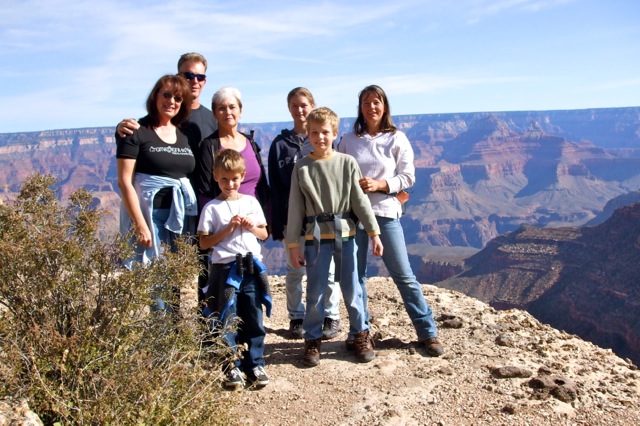
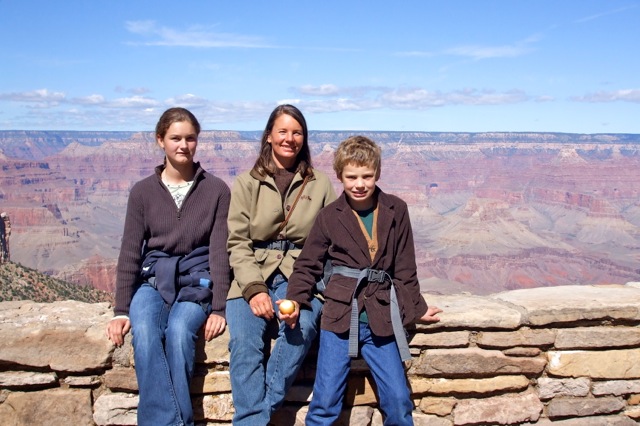
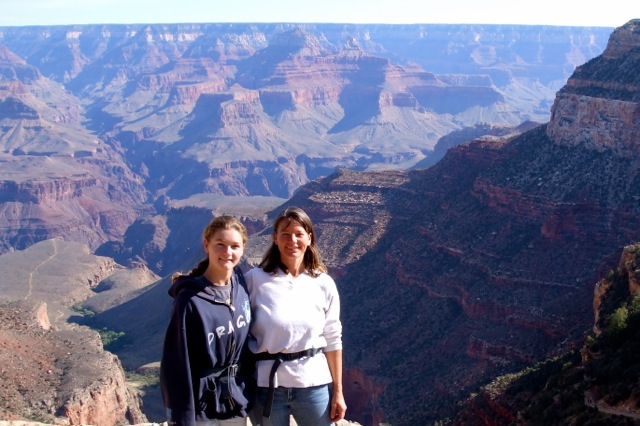
Sunday afternoon we met up with the other group members that wanted to hike along the Rim Trail east of the Village. Despite the altitude and not having slept much for the past two nights, the kids and I were bouncy with energy and eager to keep moving.

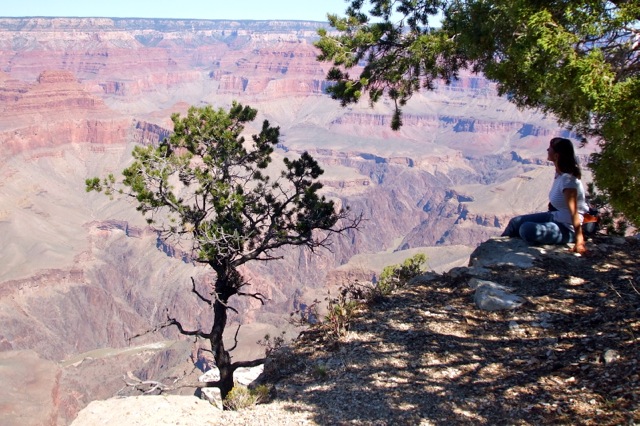
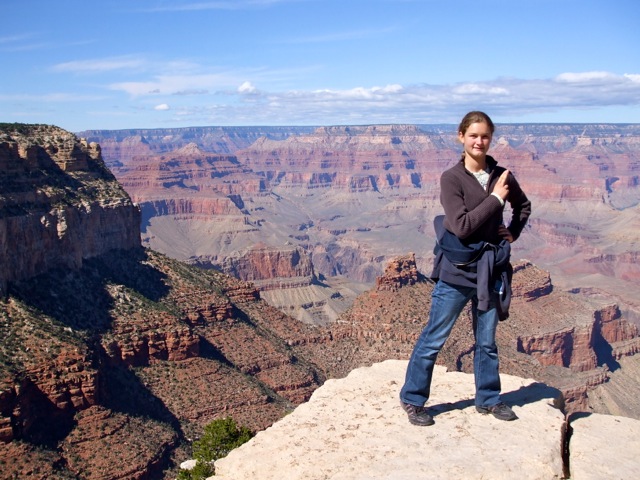
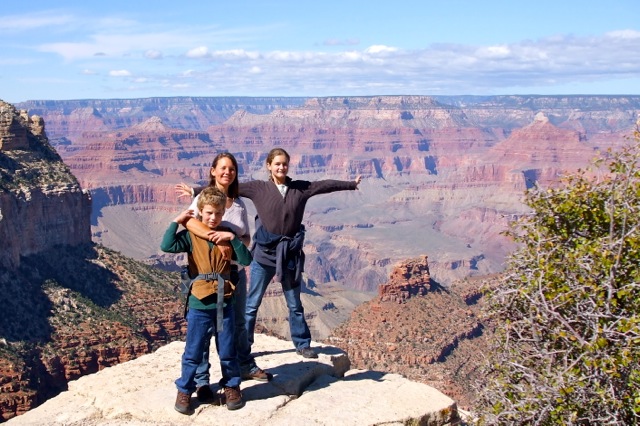
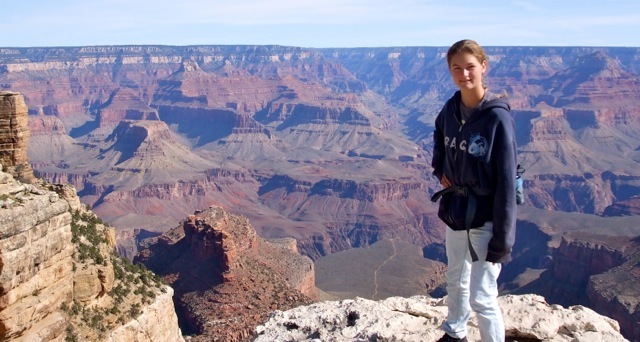
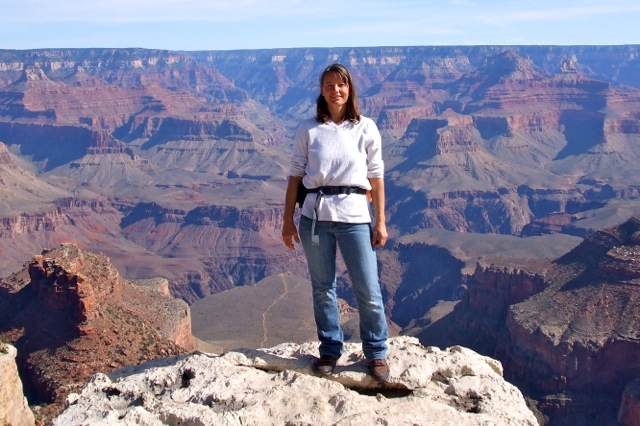
Once Elizabeth got past her initial amazement at the sheer enormity of the thing, she quickly transitioned to finding places where there was no railing or barrier between the trail and the abyss, and then finding a rocky outcropping to stand on where a fall would mean certain death, and then going out and standing on it, thusly:

I still haven’t decided whether I’m a bad parent for allowing this, or a good parent for encouraging her to live life to the fullest. Twenty years from now I’ll know which one it was, I suppose.

Luke found the Canyon actively intimidating. He was fine as long as there was a nice sturdy railing or wall between himself and the drop, but he wanted nothing to do with the unshielded outcroppings. I actually have very few pictures of Luke near the rim, and in the ones I do have he’s either on the safe side of a railing or wall (and if the wall is too low he still looks uncomfortable)…

…or there’s no barrier and I have a casual death grip on him to keep him in the photo.

Anyway. After the hike on Sunday we checked into our rooms to clean up for dinner. The group had reservations in the Arizona Room at Bright Angel Lodge, but it (and every other restaurant in the Village) was so crowded that we ended up waiting for an hour in the bitterly cold dark before our table was ready. The food was good though, and the portions were so huge that the kids and I took half our meals back to our room with us and had them for breakfast the next morning. And as we walked back to Maswik Lodge that night a small herd of deer walked fearlessly past us to graze on the Bright Angel lawns. I wish I’d had my camera with me, but I hadn’t brought it to the restaurant.

Again, some of us were ready for bed earlier than others. The kids and I were sound asleep by the time our roommate returned. This time I was so tired that I woke up briefly when she came in and immediately went back to sleep. But at some point after that she actually woke me up on purpose to ask me something. I was so groggy I barely remember it, but (as I learned the next morning) apparently she had become separated from the people she was walking back to the Lodge with, and while she was alone she had come across an elk, and the experience had unnerved her, and she felt the need to recenter herself with some Buddhist chants, and APPARENTLY I told her that would be fine. So, yeah. Chanting. In the wee hours of the morning. Even Elizabeth couldn’t sleep through that. It seemed to go on for hours, although it was probably more like thirty minutes. When she finally stopped and went to bed I fell asleep so fast that I never even heard the snoring, but apparently Luke wasn’t so fortunate: once again he didn’t get much sleep.

To describe Luke as “surly” the next morning would be a considerable understatement. As ordered, he did not say anything to our roommate, but once we were away from her and out with the group members who were hiking with us that day he complained bitterly about every little thing, and the unfairness of life in general. For the first hour or so he was just not much fun to be around.

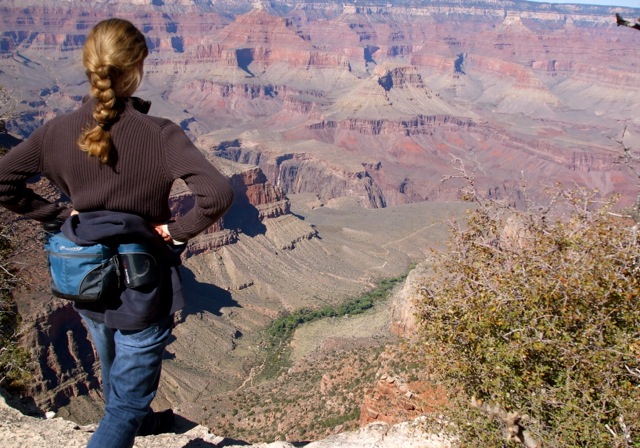
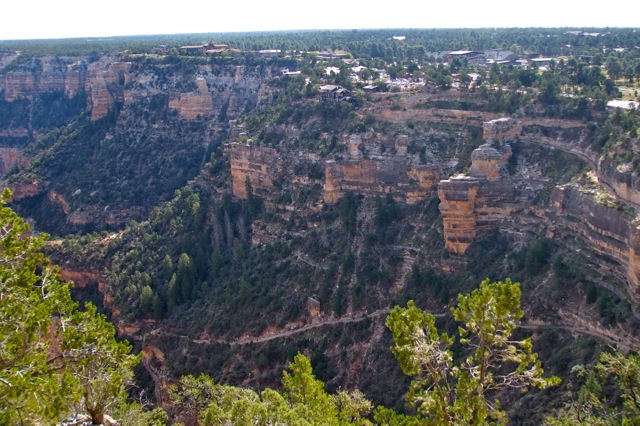
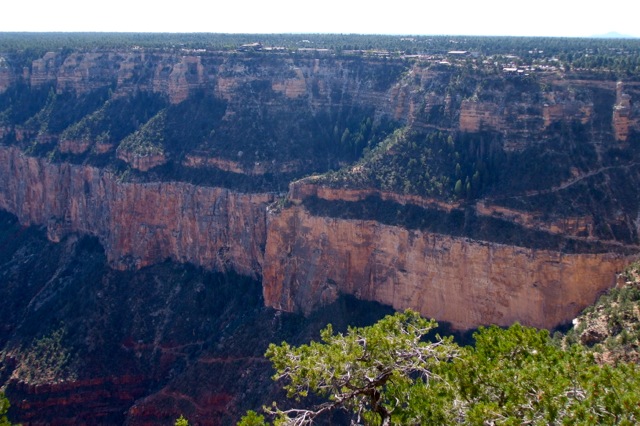
But. Monday’s hike turned out to be insanely fun. We were following the Rim Trail to the west this time, which was woodsier and less populated, and led to a series of breathtaking vistas. Even poor sleep-deprived Luke eventually recovered his good spirits in the evergreen-scented air, and he fell in with a younger boy from our group who also liked to keep a healthy distance from steep drops. They kept each other company, while Elizabeth and I spent the day terrifying each other by walking out onto increasing dangerous rocky outcroppings.

The West Rim Trail also offered wonderful views of the Village.

And this is getting pretty long, so I think I’ll stop here and continue tomorrow. Stay tuned!

Read Part III Here

Categories: Family, Friends, Humor, kids, Life, Love, Road trip, Travel, Wildlife | Tags: , | Leave a comment

Blog at WordPress.com.