
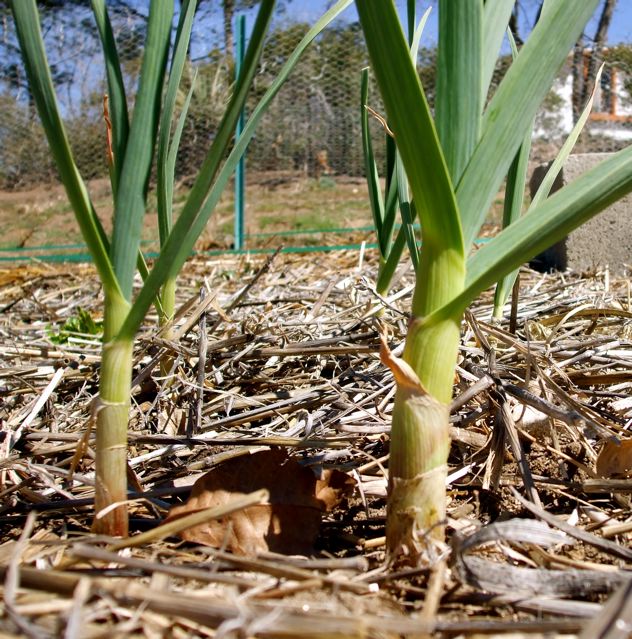
By far the most-used vegetables in my garden are garlic and onions. It’s hard to picture cooking without them — I can’t imagine spaghetti or soup or stir-fry or, well, almost any evening meal without the life and flavor they add.
***********
GARLIC:
I grow more garlic every year, but I have yet to plant enough: we keep running out. So it hasn’t really been functioning as a perennial for me (since there’s no carryover from one season to the next), but hopefully soon that will change as I figure out how much space I really need to devote to it.
In my relatively mild climate I can plant garlic just about any time and it will immediately start to grow. When my supply is running low I just buy several bulbs of organic garlic from the grocery store, break them up into individual cloves and plant the cloves two or three inches apart. They sprout right away. Within a few weeks I can begin using the young little plants like scallions in my cooking, green tops and all. Delicious!
If your goal is to plant a year’s worth of garlic at once AND have bulbs left over for supplying next year’s crop, you need to plant in the fall, because it needs a good cold spell before it will form bulbs at all. September is an ideal time to plant a nice big plot of garlic if future bulbs are your aim. But don’t feel like you have to wait until the bulb stage to use them as needed; remember, they can be chopped up tops and all and added to any recipe where garlic is called for.
ONIONS
This will be the first year I’ve tried planting perennial onions. I’ve always grown standard biennial varieties before, but like the garlic I’ve always ended up using them in the green stage and then running out before they have a chance to form bulbs, so it wouldn’t have mattered anyway.
There are several different varieties of perennial onions to choose from, most of them difficult to come by here in America. I had planned to grow potato onions or Egyptian “walking” onions, but the few nurseries that offered those had already sold out. I settled for shallots and evergreen bunching onions. Bunching onions never form bulbs, they remain in the “scallion” stage and reproduce by growing into clumps that can be dug up, divided and replanted to make more clumps. Last week I planted one bed of those from seed, and for this first summer I don’t plan to harvest them at all, beyond the initial thinning. By the time they begin to form clumps I’ll have a whole new bed ready for them over in the newly-started “perennial” side of my garden, where they won’t be disturbed by the annual spring planting upheavals.
Shallots and potato onions form bulbs, and then clumps of bulbs. They should be allowed to die back to the ground before harvesting, just like regular biennial onions.
Egyptian onions produce small bulbs on top of their stalks. When mature the stalks fall over and plant new bulbs for next year’s crop, hence the nickname of “walking onions.”
***********
Garlic and onions are heavy feeders and should be grown in rich, well-drained soil with plenty of organic material worked in. Don’t let them dry out, keep the soil moist. Some folks say you shouldn’t mulch bulbs, but I always have with good results. Either way, keep your beds weed-free: onions especially don’t compete well with aggressive plants.
***********
This is a continuing series about improving your self-sufficiency by growing edible perennials.
Previous posts on this subject:
Self-Sufficiency: Not Just For Tree-Hugging Hippies Anymore!


 An Invincible Summer