Gardening

December Watermelons? Who Knew?

I’ve not had a lot of luck growing watermelons in my home garden. The climate’s all wrong for them: at this elevation we get hot, dry days and cool (often cold) dry nights for most of the growing season. Watermelons want moist heat around the clock to really thrive, which is why they tend to grow so well in the deep South.

Still, I do love watermelons, so I keep trying every year. And I have noticed that as my soil gets richer from one summer to the next, the watermelon seeds I plant have begun to at least concede the possibility that they may eventually become productive. I get vines, and sometimes even one or two edible melons.

I should mention that my food garden is fertilized only with horse manure. We have plenty of horses, so there’s no shortage. I’ve had people tell me with great conviction that horse manure is bad for a vegetable garden: it’s too strong, or it’s not strong enough, or it has the wrong nutrients in it, and so on. In response I can only point to the glowing, productive health of my vegetables (not counting the darn watermelons of course), and keep piling on the manure.

It’s true that timing is important when you’re using fresh manure. Where I live the ground doesn’t really freeze solid in the winter, so I do my soil prepping around January or February as the weather permits. First I rake off all the remains of last summer’s crops. Then, because Bermuda grass is the unending bane of my gardening experience, I go through the entire garden and dig out all the evil invading rhizomes that have crept into my soil from the surrounding areas since last spring. I can’t dig them out over the summer without uprooting my crops along with them. Yarg!

Once the garden is thoroughly tilled and weedfree, I bring in the horse manure. I like to spread a good four-to-six-inch-deep layer on top of the broken-up soil. Ideally at this point a nice helpful rain will come along to water it in, but if the weather’s not that accommodating I just turn on the garden sprinkler for a few hours.

A few days later, or whenever the soil is still moist but no longer wet, I till again, digging the manure deep into the ground. Then I let Mother Nature handle the work of composting, which she does admirably: by spring planting time there are literally millions of earthworms going about their business in my soil, and the manure is rotted enough to be safe for seedlings.

The earthworm thing didn’t happen right away. When we first moved to this property the “soil” was really just sand and decomposed granite; nothing grew very well in it other than mustard weed, wild buckwheat and sagebrush. For the first few years I had to buy bags of planting mix from the nursery just to create pockets of soil that veggies could struggle along in. More than once I was tempted to use chemical fertilizers to boost things along (I managed to resist). The horse manure I piled on every winter seemed to vanish without a trace by the following winter. (Actually it still vanishes, but since my garden soil gets blacker and richer every year I assume the manure is playing its part in the great circle of life.)

Then I discovered the magic of mulching with straw, and things started turning around in a big way.

Wow, I’m seriously digressing here, aren’t I? This post was supposed to be about watermelons. I’ll get into mulching and fertilizing more in another post.

So, watermelons. The one crop I can’t seem to succeed with. Occasionally I’ll get a melon or two, but if I don’t pick them THE INSTANT they ripen, they very quickly rot right back into the ground. Even the earthworms seem to be against me here: they’ll wiggle up through a solid layer of straw mulch to nibble happily on the rind of a ripe watermelon.

Then there was this spring: the strangest planting experience I’ve ever had. Half the crops I planted simply declined to sprout. My soil has become so rich now that I normally only have to wave a packet of lettuce seeds at the ground and pretty soon there’s lettuce everywhere, but this year…not so much. I planted my carrot bed twice and got no carrots. Ditto with the cantaloupe seeps and the watermelon seeds. I got a handful of beets, but not nearly as many as I’d planted. Only half the corn I planted grew. My early lettuce crop sprouted, but the later planting didn’t. It was Puzzling, to say the least. It’s like the seeds somehow knew what a horrifically dry year we were going to have, and wanted to save themselves for a better year or something. Even the bell peppers, usually one of my most productive and gratifying crops, did not much of anything this year. It was always to hot or too cold for them — by the time they finally set fruit, Fall was moving in. The tomatoes, potatoes, onions, garlic, herbs and broccoli did well, but even the tomatoes and potatoes didn’t really have a stellar year.

Watermelons. Right. Focus!!

When my watermelon seeds didn’t sprout, I planted more. When those didn’t sprout, I picked up a seedling at the nursery and planted that. It sat there and sulked for a few weeks, then decided to grow. To my pleased surprise, it actually produced some very nice melons, two of which I enjoyed over the summer, and a third that I found all ripe and ready when I returned from my road trip at the end of October.

I saw another watermelon developing when I picked that last one in October, but I pretty much wrote it off. I figured a frost would get it long before it ripened.

So last Sunday I was down in the garden picking an onion for supper. I like to let the onions stay in the ground until they’re needed, since we don’t have a root cellar to store them in. They stay nice and fresh out in the garden.

Anyway, it was snowing Sunday, and all the tender summer crops were dead and blackening and kind of sludging back into the earth the way they do, and sitting there in my watermelon patch amid the dead remains of old vines was a perfectly lovely looking watermelon! It looked as fresh and ripe as a summer day. Apparently the cold weather had sent the earthworms into hibernation before it had ripened enough to appeal to them.

Out of sheer curiousity I picked it and brought it up to the house along with my onion. I wasn’t expecting much, I just wanted to see what the inside of a watermelon looks like in December. I washed it off and sliced into it.

And it was good! Crisp and sweet and juicy and red, in spite of all the hard freezes that had killed off its mother vine. It was like, I don’t know, a pumpkin or a winter squash, impervious to ice. I didn’t know watermelons could do that!

So I’m thinking next summer I’m going to try setting each young watermelon on something that earthworms and soil microorganism can’t chew their way through, like maybe pieces of wood planks, and see if they’re a bit more durable that way. Who knows, I might actually start having some real success producing watermelons!

I hope so, ’cause I do loves me some watermelons.

Now if only we don’t have another bizarro spring like that last one….
Categories: food, Gardening, Life | Tags: | 4 Comments

O Christmas Tree

He who plants a tree, plants a hope.
– Lucy Larcom

You can live for years next door to a big pine tree, honored to have so venerable a neighbor, even when it sheds needles all over your flowers or wakes you, dropping big cones onto your deck at still of night.Β 
— Denise Levertov

No town can fail of beauty, though its walks were gutters and its houses hovels, if venerable trees make magnificent colonnades along its streets.
— Henry Ward Beecher

One of the things I love best about Christmas is the way it inspires people to reach beyond their own lives, to look for ways to make the world a better place for everyone to live in. In this brief, magical season more than any other time of year parents seek out ways to teach their children the value of giving of themselves; people who have much are moved to share their wealth with those who have little; and humankind seems to draw just a little closer, however briefly, to that distant dream of peace on earth and goodwill toward men.

In that spirit, I’d like to offer a simple idea for giving a small gift of health and beauty to the earth and its inhabitants: buy a living Christmas tree this year. Most tree nurseries stock them between Thanksgiving and Christmas; some offer a better selection than others. Imagine how much more beautiful the world could be in just a few years if everyone who normally buys cut trees every December were to switch to living ones!

We’ve used living trees for the past ten years or so, and through trial and error we’ve learned that there are big differences between one species of tree and the next, and that each variety has its pros and cons. Here’s a useful summary for anyone who might be considering switching to a living tree and isn’t sure what to look for.

Pines are the least expensive and fastest growing. They don’t grow in that conical shape naturally (they are professionally pruned into the “Christmas tree” shape), so once they’re planted in the ground they’ll quickly become tall and bushy. Pruning off the lower branches as the tree grows will give you a nice shady tree with a small “footprint.” The only real downside to using pines as living Christmas trees is that they quickly outgrow their pots: if you’re looking for a tree you can keep in a planter and use for two or three consecutive Christmases, a pine isn’t what you want.

Spruces are more expensive than pines, but also much prettier and slower-growing. A medium-sized spruce should be able to live in its pot for at least two years, if it’s given plenty of water, which makes it economical in the long run. They come in many different varieties and shades of green or blue.

Firs are my personal favorite. They tend to be the most expensive, but in the past we’ve used a fir for three years in a row before planting it, and if we’d started out with a smaller one we probably could have gotten a couple more years out of it before having to plant it. Plus, firs have beautiful short, soft needles that don’t scratch up your hands and arms when you’re decorating the tree. Noble firs are the prettiest, but are extravagantly expensive in pots (I’ve seen them for over $300), so we usually go with less pricey varieties, such as Fraser.

And if you’re looking for a tree you can use indefinitely, year after year, there are dwarf spruce and fir varieties that can live in a planter their whole long lives!

A few things to remember:

Living trees shouldn’t be kept indoors more than three weeks or so. In our living room the only place to put the Christmas tree happens to be about six feet away from our woodburning stove, so anything longer than two weeks is too stressful for the tree. We bring our tree inside a week before Christmas and take it back outside on Jan 2. Water frequently!

If you plan to keep your tree in its pot over the summer and bring it back in next year, keep it in the shade and water it often in hot weather. A tree in a planter needs more water and more shade than a tree in the ground.

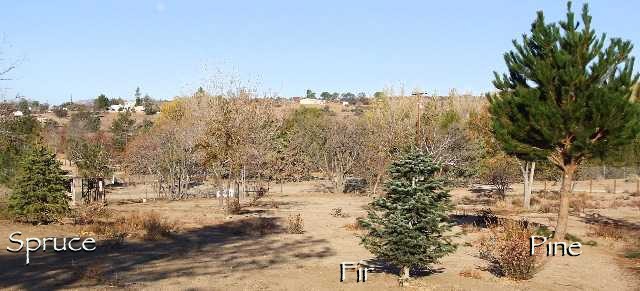
Here are three trees on our property that all started out as Christmas trees:

trees1.jpg

Don’t have room to plant a tree? Donate it to a park or anywhere a new tree would be welcomed! The earth can always use more trees.

Think of as it as a Christmas gift to future generations. πŸ™‚

Categories: Christmas, environment, Gardening, Life, trees | 8 Comments

A Winter Garden Writ Small

Always leave enough time in your life to do something that makes you happy, satisfied, or even joyous. That has more of an effect on economic well-being than any other single factor.
– Paul Hawken

Every summer as I’m delighting in the lavish bounty of my garden I promise myself that this time, for sure, I will plant a winter garden and keep the fresh veggies coming. And at some point every January or February I realize that once again the winter garden hasn’t materialized and it’s time to start preparing the plot for spring planting.

This October as I was on the return lap of my road trip I swore that the first thing I was going to do when I got home was to put in that winter garden. No excuses this time.

And then I got home, and the truth hit me. The reason why my best intentions come to naught every fall. It’s because in November, when the summer garden is fading out and the time has come to till the soil and plant winter crops, one has to make a choice: put in that winter garden…or make one’s house shiny clean and nice for the holidays.

I love the holidays. The holidays merit a shiny clean house. I also have two young children, and that house ain’t going to scrub itself.

So I got to cleaning. But I couldn’t bring myself to let go of the winter garden idea. I realized that what I need is a set of raised beds near the house, dedicated solely to stuff like lettuce and broccoli and cabbage and stuff that will grow year-round here.

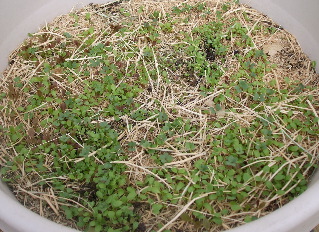
Not having time to build these raised beds at the moment (see holidays and housecleaning, above), I opted for a quick fix. I picked up the biggest plastic pot I could find at Home Depot (24″ diameter), set it up out of reach of the dogs (on a couple of old truck tires; effective if not terribly pretty), filled it full of organic potting soil and seeded it liberally with radishes, broccoli, carrots and several varieties of lettuce. I just mixed everything together; there’s no “radish section” or “lettuce section.” I figure I can eat all the thinnings and end up with a handful of adult plants spread evenly around the pot. The carrots are experimental: I’m not sure if carrots will grow in the winter here and this seems like a good way to find out.

wg1.jpgEverything sprouted very quickly; I’ll need to do a lot of thinning.

I want to take a moment to sing the praises of Hybrid Packman broccoli. This variety not only has a mild, delicious flavor, it also has the wonderful habit of growing nearly full-size heads to replace the ones you harvest — over and over, for as long as the plant lasts. I have broccoli in my garden right now that I planted last spring, that are still producing beautiful heads! So even if I only have room for one adult broccoli plant in my little winter garden this year, it should still produce a satisfactory amount of edible goodness.

As for the lettuce, once it’s big enough I like to harvest it by the leaf rather than by the head, so one plant of each variety should provide many salads. The only variety I’ve had any luck with in my summer garden is Romaine, but for the cooler weather I’m trying a few different kinds to see how they do.

I also like Cherry Belle radishes and Tendersweet carrots. I didn’t plant cabbage this fall because of space constraints, but as my winter garden setup grows I’ll be adding both green and red varieties.

I’m pretty excited about the prospect of year-round fresh-picked goodies, but experience tells me that these things rarely work out exactly as planned. I’m eager to see what thrives and what doesn’t in my little miniature garden.

Categories: food, Gardening, Life | 9 Comments

In Other News…

I opened this blog account because it seemed like a good place to post pics and snippets from my recent road trip, but while I’ve been doing that the idea of having my own long-term personal blog has been gradually growing on me. I can address a broader range of subjects here than on my Mahogany site, and I really like the extra features and sense of community that WordPress offers. I’ve gotten comfy here. :^)

So, from here on out my ramblings will leave the Interstate and venture down the many winding paths that make up my life on a small cattle ranch in rural SoCal. Favorite topics will likely include gardening, books, food, family life, ranch life, and life in general, presented in a (hopefully) witty and amusing fashion for your entertainment.

Stay tuned!

Categories: Family, Gardening, Life, Ranching | Tags: , , , , , | Leave a comment