


Years ago I used to subscribe to Family Fun magazine, and this recipe was included in the October 1999 issue. It’s simple enough for even the most casual cook to make, and it’s really delicious.
THE CRUST:
2 1/2 cups all-purpose flour
2 tablespoons sugar
1/4 teaspoon salt
8 tablespoons ice water
The original recipe calls for 1/2 cup cold butter, cut into 1/2-inch pieces, and 5 tablespoons cold vegetable shortening. Possibly this makes a flakier crust than using all butter, but considering how spectacularly unhealthy partially-hydrogenated oils are, I’m willing to sacrifice whatever textural benefits Crisco offers. I substitute an equal amount of butter. Your mileage may vary.
The secret to a perfect piecrust is to keep all the ingredients COLD, and to not overmix the butter. The method Family Fun recommended is to measure the dry ingredients into a gallon-size Ziplock bag, seal and shake it to mix them, then add the chilled butter pieces (and shortening if you opt to go that route) and just sort of press them in. The idea is to flatten the butter and coat it with flour to produce a flaky, layered crust.
I use a regular mixing bowl and just flatten the butter pieces with my fingers before tossing them in with the flour mixture.
If you’re already an old hand at making pastry crusts, just do whatever you usually do. :^)
Once your chilled butter is LIGHTLY mixed in with the dry ingredients, add the ice water. If you’re using the Ziplock method, open the bag, add ice water, reseal, the press and shake until the dough holds together (add more water if necessary, but not too much!).
Turn the dough onto a lightly floured surface, knead it together, then divide in half. Work quickly, because you don’t want your butter to get warm and melt.
Flatten each half into a disk, wrap in plastic, and chill for at least 30 minutes.
Then roll out one of the disks on a lightly floured surface until you have a circle that’s about 12 inches in diameter. Line a 9-inch pie plate with the dough, trimming any extra dough from the edges with a sharp knife. Return it to the refrigerator until you’re ready to make the pie.
THE FILLING:
6 to 8 pie apples such as Granny Smith, Cortland, Rome, or a local variety of tart apples. I highly recommend using local apples whenever possible, ideally from a “U-Pick” orchard. A freshly-picked, locally-grown apple is always going to taste better than one that’s been trucked across the country, chemically ripened in a warehouse and then stacked under bright lights in a supermarket. Also, I think the small local growers tend to go a little easier on the chemical pesticides and whatnot than the big commercial growers. And if you can find a local organic orchard, score!
Okay, where was I? On my soapbox, apparently.
Juice of half a lemon
3/4 cup sugar
1 teaspoon cinnamon
1/4 teaspoon nutmeg.
2 tablespoons all-purpose flour
2 tablespoons butter, cut into chunks
milk (for glaze)
Heat oven to 425º.
Meanwhile, peel, core, and slice your apples into 1/4 inch slices. You should have about 6 cups worth of sliced apples; place them in a large mixing bowl.
Pour the lemon juice over the apples and add the sugar, cinnamon, nutmeg and flour. Toss well. Spoon the spiced apples into the lined piecrust and dot with the butter pieces.
The top crust can look like whatever you prefer. You can roll it out, cut it into strips, and make a latticework crust if you’re really ambitious. Or just roll it into a circle, set it atop the apple mixture, and crimp the edges together with the tines of a fork. Remember to cut slits in the dough to let the steam escape. Brush the top with milk for a glaze.
Place the pie in the preheated oven and bake for 45 minutes, or until the crust is golden brown and you can see the juices bubbling. If the crust begins to brown before the pie is fully baked, cover it with foil.
Let the pie cool before slicing it into wedges. Serves 8.
Sorry I don’t have a picture.
Hey wait — this is the Internet! Here ya go:
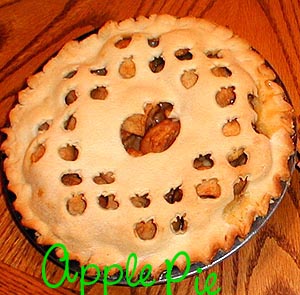
PS. If you actually succeed in making a pie that looks like the one in the picture, do let me know your secret. Mine come out very tasty but not nearly that pretty, and I’ve never gotten the hang of getting decorative cutouts to hold their shape during the transfer from countertop to pie.
“To own a bit of ground, to scratch it with a hoe, to plant seeds, and watch the renewal of life – this is the commonest delight of the race, the most satisfactory thing a man can do.”
–Charles Dudley Warner
I’ve finally gotten all my spring veggies planted, and most of my summer ones. This has been an unusually cool spring, but I didn’t want to wait any longer to get everything in the ground. We had a totally unexpected hard frost a couple weeks ago that decimated my bell peppers and eggplants, but other than that things are looking really good. I replaced the frost victims with new seedlings and I’m keeping a much closer eye on the weather now, so I can cover up the tender stuff with straw should the need arise.
Here’s what my garden looks like right now:

As you can see, I’m all about the mulch. You really can’t garden without it in this arid climate. It holds moisture in, blocks weeds, adds organic matter to the soil as it decomposes, and keeps the plants’ roots cool so they don’t burn up in the broiling heat of summer. Gotta have the mulch!
I’ve gone in a slightly different direction this year with my crop selections. The more I read about Colony Collapse Disorder, the more concerned I get about the effects of genetically modified plants on the beneficial insects that come into contact with them. This has inspired an interest in preserving old heirloom and open-pollinated varieties of crops. The added bonus here is that I can save the seeds my plants produce and they will breed true year after year, unlike hybrids.
So I’ve switched from my usual super-sweet hybrid corn to the old favorite Golden Bantam. Instead of my beloved Hybrid Packman broccoli I’m trying an Italian heirloom variety called Di Cicco. I couldn’t give up hybrid tomatoes completely — gotta have my Early Girl and my Sweet 100 Cherries — but I’ve added Red Brandywine and Roma this year.
What I’ve planted so far:
Arugula
Beets
Broccoli
Carrots
Eggplants, Black Beauty and a Japanese variety called Ichiban
Garlic
Green Beans, Kentucky Wonder
Italian Parsley
Kale, two different varieties with really long names
Lettuce, several different varieties
Malabar Spinach
Melons, an Amish cantaloupe type
Onions, Walla-Walla and Yellow Ebenezer
Oregano
Peas, Snow and Sugar Snap
Potatoes, Yukon Gold
Radishes
Red Cabbage
Sorrel
Sweet Corn
Swiss Chard
Thyme
Tomatoes
Watermelon, Crimson Sweet and Garrison
I’m going to put in some pumpkins later; I’ve learned not to rush that. Nothing worse than pumpkins that are ripe in August and rotten by Halloween!
I also put in a bed of strawberries, but that’s a post unto itself.
I’m having the usual luck with my watermelons so far — which is to say, very little — but I think that’s another post too.
Here’s hoping for warm weather, no more frosts, and just enough rain!
Fifteen years ago I read a book called “Last Chance To See,” by Douglas Adams and Mark Carwardine. It’s a nonfiction work; basically the two men got to talking one day about all the major animal species that were teetering on the brink of extinction. They decided to travel around the world and see some of these animals for themselves, before it was too late for anyone to ever see them again. Depressing subject, very engaging book. I read it in my hammock, in my hideout, surrounded by nature’s wild beauty, and I found myself profoundly moved by the stories of all those vanishing lives.
Today during supper Luke was asking about all the different ways the earth is being polluted, which got me thinking about one of the most heartwrenching chapters in that book: the story of the baiji, or Yangtze River Dolphin.
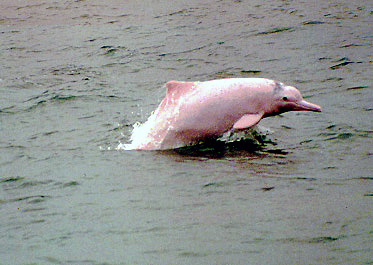
The authors described in unflinching detail the hellish life these pink (!) dolphins endured in one of the most polluted and overtrafficked rivers in the world. I think the plight of the baiji affected me more deeply than anything else in the book. I was telling the kids about them, and they wanted to see a picture of one. There were no baiji photos in the book, so I hopped online and Googled them.
And learned that the Yangtze River Dolphin was declared officially extinct last summer. Gone forever, no more baiji.
That sucks.
 An Invincible Summer