books

Everything But Money, Part I

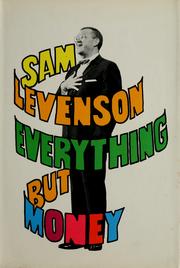
I’m reading an amazing non-fiction book right now. It’s called “Everything But Money,” by Sam Levenson, and it was first published in 1949. The edition I’m holding is the fourteenth printing, published in 1966, and it contains mentions of events as recent as 1965, so it must have been updated as it was reprinted.

The book is in four parts. In Part 1 the author (who was born in 1911) describes his childhood in the poorest slums of Brooklyn, NY. His parents were Jewish immigrants, I think from Russia or thereabouts, and they had eight kids altogether while barely managing to stave off starvation under conditions of the most abject poverty. Although “abject” might not be the right word: his parents never saw a lack of money as any kind of excuse to fail in life, and they put a great deal of effort into their children’s education and moral guidance. The author grew up in a family that was financially destitute but very rich in love and support. Because of this, he and his seven siblings all overcame the poverty of their childhood and became successful in their adult lives.

In Part 2 the author talks about how different the experience of family life and parenting his own children is in the environment of middle class affluence and national prosperity of the 1950’s and ’60’s. He wonders if in some ways the benefits of “the good life” are actually detrimental to the healthy development of the younger generations. He talks about the ways in which society is failing those generations. By modern (2012) standards, the America he lives in sounds impossibly sane and prosperous, a sad reminder of how far we’ve fallen since those post-WWII glory days. It leaves the reader with the wistful sense that if more people had thought the way he did things might have gotten better instead of worse.

Part 3 is basically a personal monologue describing the author’s own outlook on society in general and parenting in particular. I don’t know what Part 4 is about, because I haven’t gotten there yet. But Part 3 keeps blowing my mind in the best possible way. I’d like to share some excerpts from it here, over the next few days, because I think in these modern times those philosophies and values are more relevant than ever.

So here’s my first offering:

I believe that each newborn child arrives on earth with a message to deliver to mankind. Clenched in his little fist is some particle of yet unrevealed truth, some missing clue, which may solve the enigma of man’s destiny. He has a limited amount of time to fulfill his mission and he will never get a second chance — nor will we. He may be our last hope. He must be treated as top sacred.

In a cosmos in which all things appear to have a meaning, what is his meaning? We who are older and presumably wiser must find the key to unlock the secret he carries within himself. The lock cannot be forced. Our mission is to exercise the kind of loving care which will prompt the child to open his fist and offer up his truth, his individuality, the irreducible atom of his self. We must provide the kind of environment in which the child will joyfully deliver his message through complete self-fulfillment.

When he is born we give him a public name. This provides only tentative identification until he finds his own true name, his potential at birth so completely realized that he and his work and his name become one. To have lived without having “made a name for himself” is virtually to have died at birth. We cannot allow him to be born a VIP and to die anonymously, often ignominiously. We cannot afford the loss of a single soul. We have already lost too many.

** ** **

I’ll post more as I get the chance. Meanwhile, the book is currently out of print but you can read it online here for free.

Categories: books, Family, kids, Life | Leave a comment

Japan and Russia, 1905 (Part III)

This is an excerpt from a school essay written in 1905 about the Russo-Japanese War, entitled “The Destiny of the Far East.”

Part I

Part II

***********************************

In view of the present struggle in the far east it is perhaps of general interest at this time to consider the possible results. This war is one which involves not only the interests of Japan and Russia, but its ultimate outcome is certain to affect the material and moral welfare of the entire world. The far-Eastern question, like that of the near East, is made up of a group of problems which cannot be solved by isolation.

Who can forecast the destiny of Russia? With a total war-footing of almost three million in troops, an irresponsible monarch, a discontented populace, and the doctrine of hereditary aggression as the ruling motive of imperial action, can we hope for peace? That liberty in the full sense of that debatable term should come to Russia this year or next is impossible, for her people have not yet reached that stage of advancement to be capable of governing themselves. Russia has been stamped not only as the most despotic, but most barbarous of civilized nations. On the other hand the rise and growth of the Japanese empire to the stature of a world power is the marvel of the twentieth century. (In Japan we see the rising of a new sun but can only dream of what it will be when it reaches its glorious meridian.) The chief characteristics of the Japanese people are summed up in the assertion that they are honest, ingenious, courteous, frugal, animated by a strong love of knowledge and faculty of imitation, and possessing a sentiment of personal honor exceeding that of any other nation. It is but just to say that victory should come to the people whose achievements along the line of progress have been such as to surprise civilization. For Japan the war is a national necessity, she must expand or die.

Russia’s traditional friendship with this country is very much ridiculed by many of our newspapers, her civilization and government are condemned, and her trade policy in the far East is criticized as a menace to our commerce there. Our papers recall with pride the fact that it was an American Commodore Perry, who in 1804, opened Japan to civilization, and they now look upon Japanese ascendancy as the hope of Asia. Japan is not only fighting the battle of progress and civilization in placing herself in opposition to Russian advance in Asia, but she is standing as the champion of commercial rights in whose main tenance no nation is so vitally interested as the United States. With Japan paramount it is the belief of the observing class that American trade and influence in Asia would enjoy a rapid growth; while with Russia paramount it is believed that our merchants would find the door closed against them.

Russia may be grasping and aggressive: she can afford to leave the whole of Korea to little cramped up Japan. But this does not warrant the assumption that she represents reaction while Japan is the champion of liberalism and progress in the present contest.

The great purpose of Japan has not been to win victories so much as to impress upon the Russian government the absolute futility of Russia maintaining in the far-East such an empire as would menace the national existence of Japan. When we think that the main point of the Japanese demand was that of carrying out the Russian pledge to the Peking Powers,to maintain the administrative entity and territorial integrity of the Chinese Empire — a Mckinley-Hay policy which Russia had bound herself to keep by a sacred pledge alike to the United States and other Peking treaty signers as Japan. American sympathy must be with a nation that has made this common grievance, and peculiarly American grievance, all her own, and inasmuch as the battle of the Japanese nation is to punish Russia for the shameless perfidy in sight of the world in Manchuria, and to enforce the Russian promise of the open door for all the world in China, the Japanese nation’s battle is ours.

Manchuria and Korea treaties and the rights of settlement are but the flying flags of the skirmish line by the side of the great issue which drove little Japan into the last of independent Asiatic lands to fight for the independence of the yellow race in Asia. In reality, China is sick, and only Japan can save her. If Russia wins the Asiatic sun will set to rise no more, and China like India, Japan like Turkey, will be subject to the European system and its oppression. If Japan wins China will be reorganized under Japanese influence and half of Asia, and a third of the human race will enjoy liberty and self-rule. Whether Japan be victorious or defeated in her great struggle with her mighty foe, the moral victory of the Japanese people seems already to be absolutely complete and it is impossible to overestimate the value of it. She pursues no egotistic purpose, but seeks the subjugation of evils hostile to civilization, peace and enlightenment and her victory might well result in a great advantage to the peace, prosperity and true religiousness of the entire world. Besides she has proved the reality of her own physical and spiritual ideals. Let us hope the sun of Japan is now rising and her far-famed victories are but the heralds of what is to be when it reaches its full glorious meridian.

The heart of every American leaps with pride and reverence when he beholds the bright and glittering folds of the “Stars and Stripes;” but his patriotism is not mere hollow idolatry of national strength and grandeur but is genuine adoration and gratitude for the full measure of freedom and protection from the oppressors’ power. Fierce and long were the struggles for freedom from the rule of oppression, and because of these struggles our sympathies always go out to any nation struggling for its rights among nations, but victory always perches on the banner of right. He who neither slumbers nor sleeps, and who even marks the sparrow’s fall, holds also the destinies of nations in His hands.

Let us hope that back of this fierce war-cloud the gentle beams of peace are even now ready to burst forth in rich splendor, shedding their magnificent rays of goodwill and brotherly love over both friend and foe, and dissolving the gloom of hatred and oppression.

Let us hope that the consummation of this struggle will hasten that golden age of Peace when men of skill and resource will cease to seek the destruction of their fellow-men; when the sword shall be sheathed and drawn no more forever; and all humanity, regardless of race or caste, shall unite in the consummation of that one crowning principle: “The fatherhood of God, and the brotherhood of all mankind.”

~ Finis ~

Delivered by Clyde Jenkins, Cable, Ohio.

May 5, 1905

***********************************

Categories: books, Life, School | Tags: , , | Leave a comment

Japan and Russia, 1905 (Part II)

This is an excerpt from a school essay written in 1905 about the Russo-Japanese War. Read Part I here.

***********************************

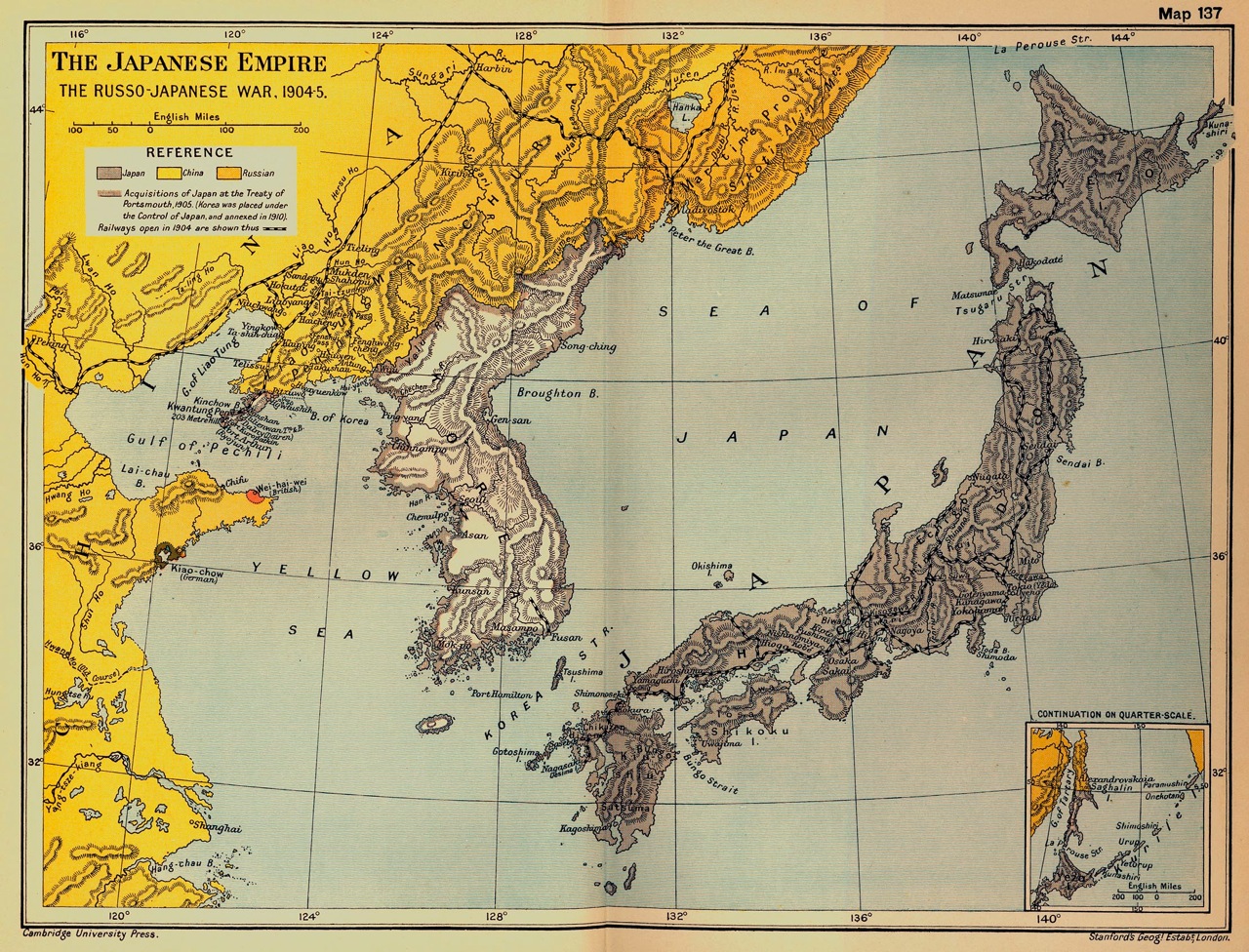
Now go with me for a moment and look in upon this situation from the Japanese standpoint. If Russia is fighting for the accomplishment of what she regards as her imperial destiny, for her commerce, her prestige, and her standing as a great oriental power, Japan, on the other hand, is battling for something far more vital — for her very existence as an independent nation. She has seen the Russians march across the vast continent of Asia until they reach the shores off which their own islands lie. She has seen them take Saghalien from her by the right of the stronger hand. She has seen them rob her of Port Arthur, the prize she won by her victory over China, and take it for themselves. If she continued her advance by absorbing Korea, Japan’s position would be irretrievably ruined. A glance at the map will show that Korea is, as a Japanese statesman declares, an arrow pointed at the heart of the island empire. Geographical and ethnical reasons make it imperative that Japan should have Korea.

We of the United States have notified the world that we will go to war rather than permit any European nation to encroach upon the American continent. Certainly we cannot blame the Japanese if, after seeing Russia absorb one stretch of Northern Asia after another, they are not willing to stand by with idle hands while she removes the last barrier between themselves and their quenchless earth-hunger. They refuse to let her plant her guns in sight of her shore. They decline to accept a situation so ruinous to the standing of Japan, so menacing to her existence as a nation. If they must go down before the Russian advance, they would rather go down fighting than standing still. Such is the spirit that animates every soldier and every sailor of Nippon in the present struggle.

While she disclaimed any intention of formally annexing Manchuria there were so many signs of permanent control by Russia in that province that Japan had taken alarm. being unable to reach any agreement, Japan struck the first blow by attacking the Russian fleet in Port Arthur on February 8, 1904. Japanese troops began to move into Korea on Feb. 18 and began a series of campaigns unexcelled in brilliancy by any of which history tells. Two and one-half months sufficed for the occupancy of Korea. The Japanese army now pressed northward and began the invasion of Manchuria. The story of the land campaign in Manchuria is one of an almost unchecked Japanese advance and a brilliantly executed Russian retreat. The main interest of the war has without a doubt centered about the siege of Port Arthur, which lasted from June to January and was marked with terrible losses and great gallantry on the part of both besieger and besieged. This town surrendered to the Japanese January 1st. The surrender of Port Arthur is followed by many minor battles which for the most part resulted disastrous to the Russians. On March 10 was fought at Mukden the most tremendous battles of modern times, if not all history, and resulted in a disastrous defeat to the Russians and their being caused to resume their retreat northward with the army of Nippon in hot pursuit. The smallest of the so called civilized powers fought it against Russia, the largest empire on earth, geographically speaking, and, as all military Europe told us, the greatest of military powers. Although peace seems in the far distance, Japan is now virtually in possession of all the points in dispute, while Russia, with broken prestige in Asia, faces a political and economic crisis at home.

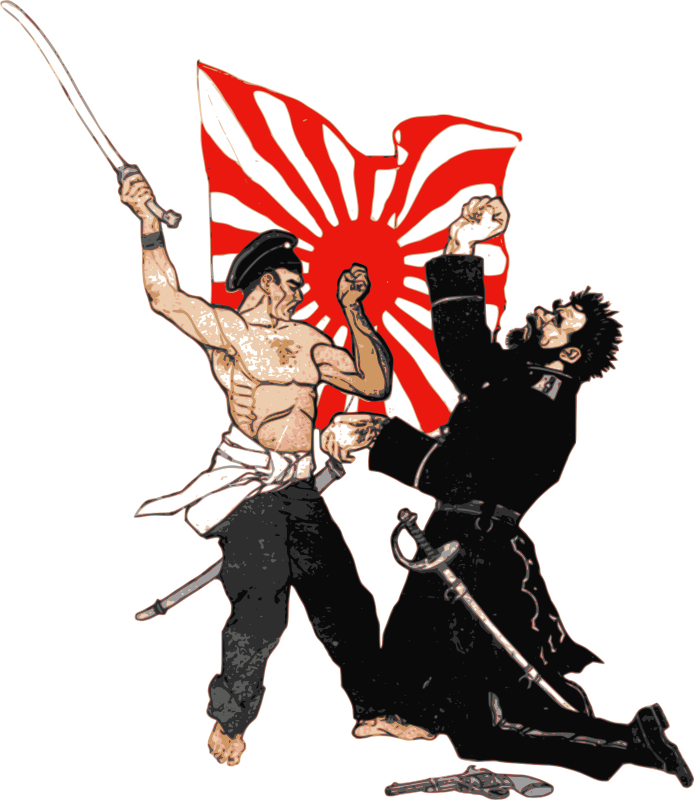
Russo-Japanese_war_combatants***********************************

To Be Continued!

Categories: books, Life, School | Tags: , , | Leave a comment

Japan and Russia, 1905 (Part I)

When our house’s previous owner sold it to us she left behind several sheds full of books and other random items in various states of decay. Most of the stuff had been destroyed by weather, rodents or just the passage of time, but there were a few treasures to be found among the trash. Thirteen years later I’m still working my way through the literally hundreds of books that survived in decent shape, protected by stacks of their less-lucky brethren.

The previous owner was an elderly woman whose mother had been a teacher a LONG time ago, so there were also some nice turn-of-the century scholastic memorabilia items, like fancy wooden pointers and brass handbells and ooooooold textbooks and such. Years ago when I was first sorting it all out I gave the oldest antique books their own high shelf in my computer room, away from sticky and curious child-hands, and resolved to look through them more closely during some hypothetical stretch of leisure time in the future. (More than a decade later most of those old volumes remain unexplored. What is this “leisure time” of which you speak?)

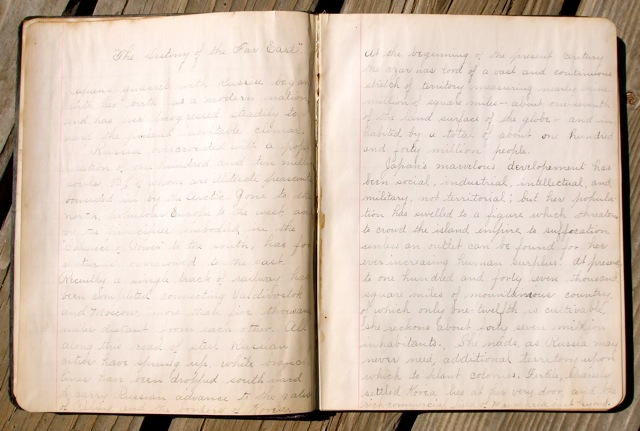
A few weeks (or possibly months? The tempus, she fugit) ago I was searching that shelf for a particular textbook on basic physics that I thought Luke would enjoy, and I came across an old handwritten journal of what appears to be school essays. I pulled it down to read, and found myself completely enthralled by the first essay: a vivid description of the Russo-Japanese War and its predicted effects on the rest of the world, written in May of 1905 while the war was still being fought. This was before Hiroshima and Nagasaki, before Pearl Harbor, before both World Wars, back when relations between Japan and the US were friendly and unstrained. It was before Krushchev, before Stalin or Lenin, when Imperial Russia was the largest country in the world and ruled by an Emperor who was likewise on good political terms with the US for the most part. The essay’s author had some definite opinions of his own but in general it’s a fascinating, educational and relatively objective glimpse into a younger, much more optimistic world. I like it so much that I’ve decided to transcribe it here so that you, dear Internet, can read it for yourself. I’m going to break it up into three or four chunks, because it’s rather long. I’ve corrected some minor spelling and punctuation errors, but otherwise it’s a faithful copy of the original. Enjoy!

***********************************

THE DESTINY OF THE FAR EAST

Japan’s quarrel with Russia began with her birth as a modern nation, and has ever progressed steadily toward the present inevitable climax.

Russia, overcrowded with a population of one hundred and ten million souls, 90% of whom are illiterate peasants, bounded in by the Arctic Zone to the north, populous Europe to the west, and by the principles embodied in the “Balance of Power” to the south, has for centuries overflowed to the east. Recently a single track of railway has been completed connecting Vladivostok and Moscow, more than five thousand miles distant from each other. All along this road of steel Russian cities have sprung up, while branch lines have been dropped southward to carry Russian advance to the gates of Peking and the borders of Korea. At the beginning of the present century the czar was lord of a vast and continuous stretch of territory measuring nearly nine million of square miles — about one-seventh of the land surface of the globe — and inhabited by a total of about one hundred and forty million people.

Japan’s marvelous development has been social, industrial, intellectual, and military, not territorial; but her population has swelled to a figure which threatens to crowd the island empire to suffocation unless an outlet can be found for her ever-increasing human surplus. At present, to one hundred and forty seven thousand square miles of mountainous country, of which only one-twelfth is cultivable, she reckons about forty seven million inhabitants. She needs, as Russia may never need, additional territory upon which to plant colonies. Fertile, sparsely settled Korea lies at her very door, and the rich commercial field of Manchuria lies beyond. Both countries desire the commerce of Korea and Manchuria, but the quarrel between them turns upon a far more vital issue than any trade question. Russia’s age-long ambition has been to reach the open ocean and to possess ports that would give her an unfettered outlook upon the world. Unable to face the combined forces of the western nations, Russia moved along the line of least resistance and spread eastward. Here her conquest was easy and finally she reached the ocean. She gradually extended her frontier southward and built the fortified port of Vladivostok. A significant name, for that it means “the control of the east.” By diplomatic and military moves they occupied Manchuria. But now she began to desire Korea, just as a century ago, owning the Atlantic and Gulf coasts, desired Florida, and she took steps to get a footing there.

Is the mighty empire to be halted in her forward march? Is she to be prevented from rounding out her position on the Pacific? Is she to be driven back from the ports that she has striven so long and hard to win? Is she to suffer a loss of prestige that would be almost as disastrous to her as the wresting from her of valuable territory? It does not seem possible that she can accept such a tremendous and crushing defeat so long as she has strength left to strike against the daring islanders who have challenged her to battle.

***********************************

Part II

Categories: books, Life, School | Tags: , , | 3 Comments

Seriously, 2011? Seriously?

Everywhere I look people are grumbling “Good riddance to 2010! What a crappy year!” Twitter, Facebook and most of my favorite bloggers seem to be in agreement about the epic suckitude of the past twelve months.

As usual I’m the oddball: I had a GREAT 2010. Truly a fantastic year for me and the kids.

2011 is, sadly, shaping up to be less than stellar. I know we’re only three days into it, but let’s take a look at what we’ve got so far:

On New Year’s Eve morning I woke up with the sort of head/chest cold and fever that erodes one’s will to live. And then it wouldn’t freaking go away. New’s Year’s Day I was still dragging around congested, feverish, coughing up smurfs and generally being a big whiner. Yesterday I finally kicked the fever and got my energy back, but all of the other symptoms are, as of today, still firmly entrenched in my respiratory system. This is what I get for bragging that I never get sick anymore since I started growing my own food.

This morning we woke up to about a half-inch of snow. My little car slipped and slid all the way to the bus stop. I suspect that I have the wrong vehicle for my location. Anyway, the bus was very late so I shut the car off while we waited, and than after it finally came and the kids left my car would not restart. It clicked like a bad starter, but the oil pressure and battery lights were both lit. I could have called AAA, but I was wearing my pajamas, a bathrobe, worn-out Uggs and a ratty Carhartt jacket, and was feeling less than presentable. I could have walked home, gotten dressed, called AAA and then walked back to the car, but it’s a about a mile along a paved road just to get to the driveway and see above regarding my stylish ensemble. So I gritted my teeth and called Steve. And he came and gave my battery a jump and my car started and I drove home. So before I get on with the grousing about how I probably need a new starter and I have no money and why did this have to happen right after Christmas, let me take a moment to marvel over the mindboggling fact that Steve has become one of the most dependably helpful people in my life lately. It is almost painful for me to admit that, and I would rather eat thumbtacks than take advantage of this inexplicable grace, but the fact remains that in the past year or two he has been there for me in moments when no one else was and I am deeply grateful.

And now: Probably need new starter, no money, why right after Christmas, etc. /grouse

So 2011 is getting off to a shaky start for me. I’m really hoping it’s just getting all the bad stuff out of its system right at the beginning, so the rest of the year can be drama-free. Yay optimism!

*****************

In other news:

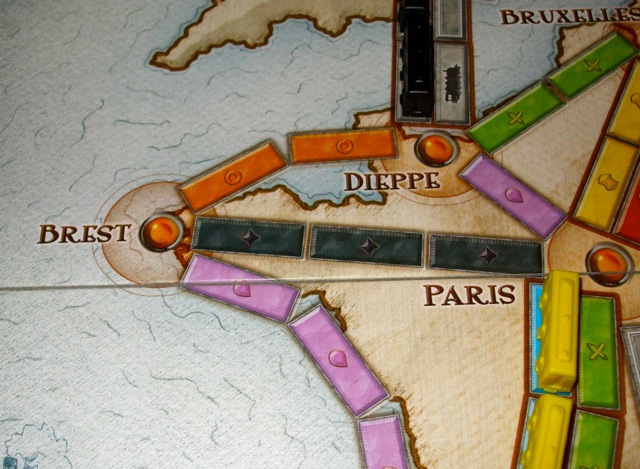
Luke has a passion for turn-of-the-century (as in 1900) machinery and steam-tech, especially in European settings, so the game Ticket To Ride: Europe was an easy pick for one of his Christmas presents. It’s a lot of fun to play, but the gameboard is basically a map of Europe and we don’t know how to pronounce some of the city names. Most of them we can figure out because we’re familiar with the English translation, like Bruxelles and København (Brussels and Copenhagen), but others we just have to guess at. Sure, we could Google the correct pronunciations, but because we are children we prefer to substitute our own words in place of the names. All of this is to explain the following exchange from a few nights ago:

Luke: “I’m claiming the route from Breast to Diaper.”

Me: “Ah, yes. Pretty short trip, as I recall. About twenty minutes, usually.”

Yes, I am twelve. And so is my ten-year-old son.

*****************

Speaking of twelve-year-olds, I also got Luke two of the “Diary Of A Wimpy Kid” sequels, “The Last Straw” and “The Ugly Truth,” since he enjoyed the first book so much. He and Elizabeth have both spent the past week reading, rereading, laughing at and quoting their favorite bits from both of them. I haven’t read any of the series myself yet, but just going by how much my kids love these books I have to recommend them to anyone with kids in the 10- to 15-year-old age group. Luke doesn’t read a lot of fiction, he’s more into history, science and machinery, so for a kids’ book to grab his interest this hard it has to be exceptionally entertaining. If you have kids of middle school age or thereabouts, check this series out!

*****************

And now I am off to eat a bowl of frozen pomegranate seeds, because they are magical and will restore me to full health. Any day now.

Categories: books, Family, Gaming, Health, Humor, kids, Life, Nutrition, Weather, Winter | Tags: , | 2 Comments

Blog at WordPress.com.